

Collaborative Robots Market to Witness 21.4% CAGR during 2026 and 2033 Owing to Increase in SME Adoption
Rapid adoption of human-robot collaboration and low-code automation platforms is enabling smaller players to deploy robotics without complex infrastructure. The integration of generative AI with tactile sensing is fundamentally transforming cobots from simple repetitive tools into dynamic problem-solving assistants.
New York, NY, March 16, 2026 (GLOBE NEWSWIRE) -- The collaborative robots market is entering a period of accelerated growth as industries increasingly adopt flexible automation solutions designed to work safely alongside human workers. The collaborative robots market is projected to expand from USD 2.8 billion in 2026 to USD 10.9 billion by 2033, registering a CAGR of 21.4% in between the same period. Cobots are designed with advanced sensors, vision systems, safety features that allow direct human interaction without safety cages, making them suitable for dynamic production environments. Collaborative robots market surges as human-safe automation systems boost productivity and flexibility across modern manufacturing lines.
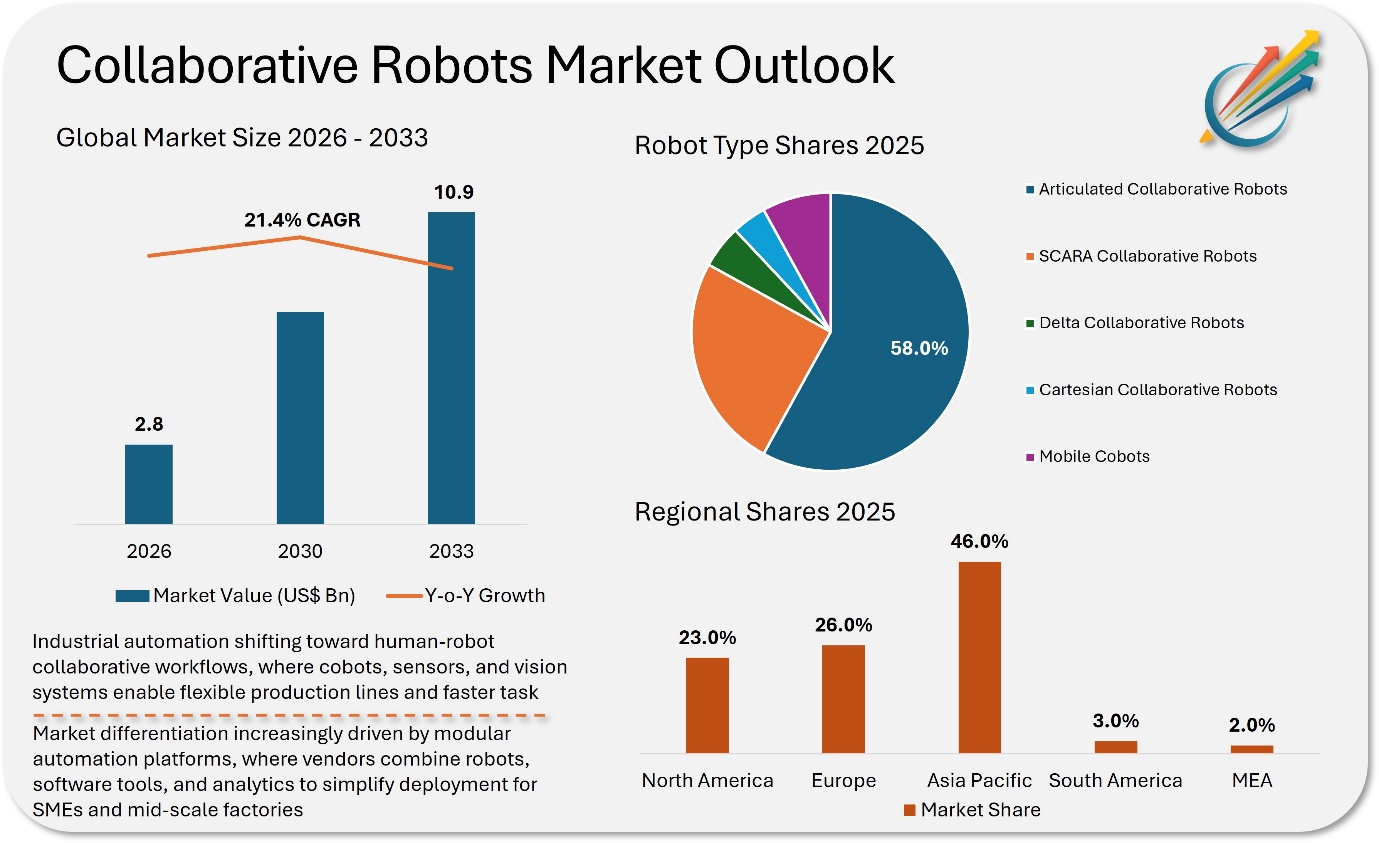
Growing labor shortages, rising operational costs, increasing demand for manufacturing agility are pushing end user companies toward collaborative robotics. Unlike traditional industrial robots, cobots offer easier programming, lower deployment costs, faster integration, etc. within existing production lines. Regulatory advancements in industrial safety standards and improvements in AI-driven perception systems are further enabling safe human-robot collaboration. Since, Industry 4.0 initiatives expand globally, cobots are becoming a critical component in smart factories, enabling scalable automation across both large and small-to-medium enterprises.
Access the Executive Summary & Sample Data: https://marketmindsadvisory.com/request-sample/?report_id=17743
Key Takeaways from Collaborative Robots Market
- Collaborative robots market is anticipated to reach USD 10.9 billion by 2033, growing at an annualised growth rate if 21.4%.
- The 3-10 kg payload segment is estimated to remain prominent revenue contributor for general manufacturing.
- Articulated cobots is the largest revenue-generating robot type due to their versatility across manufacturing tasks
- AI-enabled quality inspection is projected to be the fastest-growing application during the forecast period.
- South Korea and China are emerging as key investment hotspots in collaborative robots market owing to state-backed automation drives.
- Competitive intensity increasing due to innovation in AI vision systems and strategic robotics acquisitions.
- Rising demand for mobile manipulation (cobots on AMRs) is creating lucrative opportunities in logistics.
Market Dynamics Shaping the Collaborative Robots Market
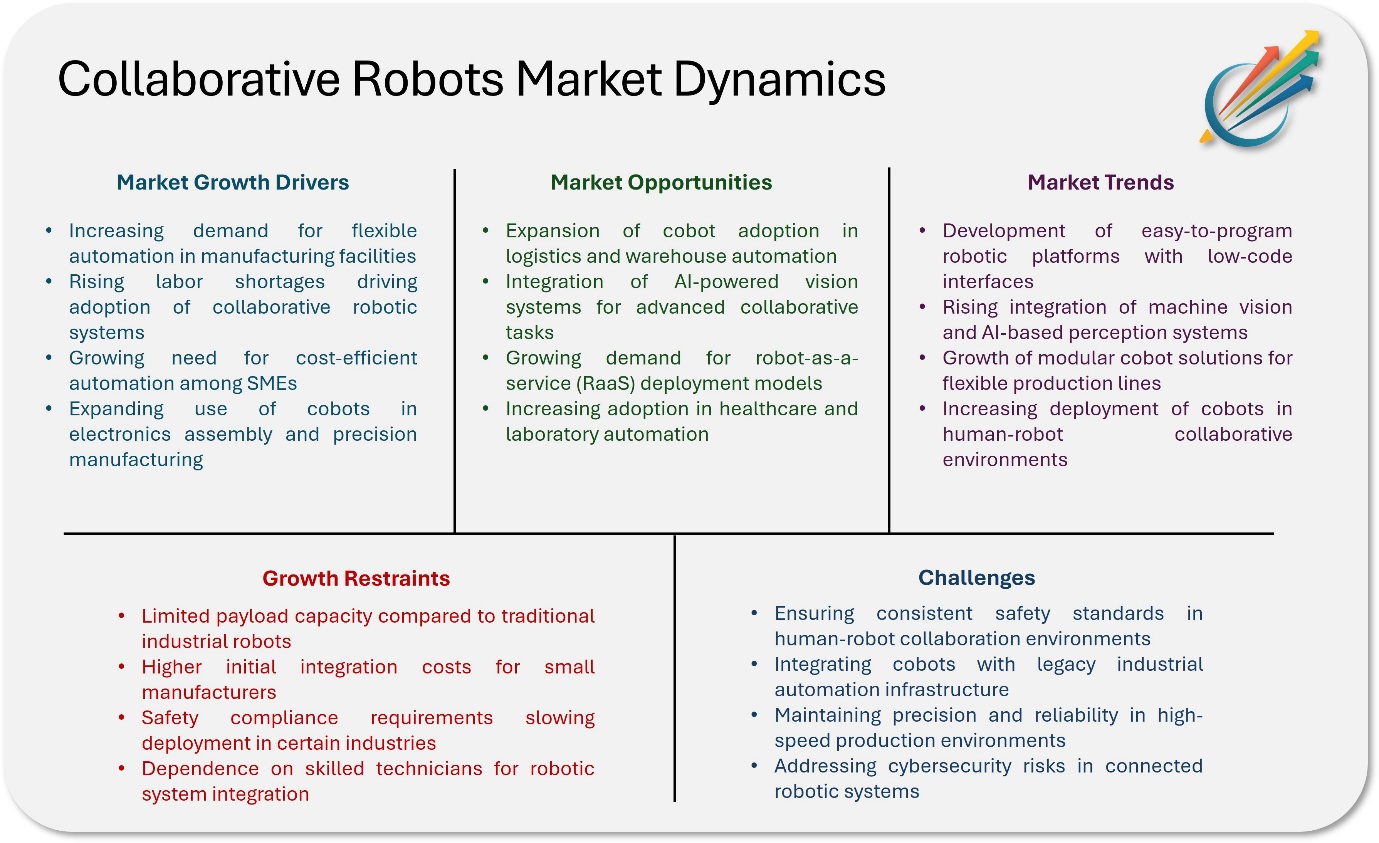
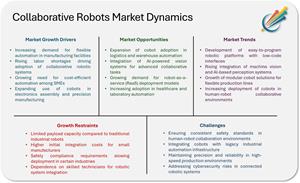
Demand for Flexible Automation in Modern Manufacturing Boosting Collaborative Robots Market
Growing demand for flexible production systems is one of the key drivers in the collaborative robots market. Key market players are facing labor shortages, fluctuating production volumes and increasing customization requirements. Cobots address these challenges by enabling automation that can easily adapt to different tasks without extensive reprogramming or infrastructure changes. Their intuitive programming interfaces and integrated safety features make them suitable for deployment even in smaller production facilities. Industries such as, electronics, automotive, consumer goods and others are adopting cobots to enhance productivity while maintaining operational flexibility.
Adoption Among Small and Medium-Sized Enterprises creating Lucrative Growth Opportunities in Collaborative Robots Market
Small and medium-sized enterprises represent a major growth opportunity for collaborative robots market. Conventional industrial robots require significant capital investment and complex system integration, limiting adoption among smaller manufacturers. Cobots offer affordable and modular automation solution that can be implemented without large-scale infrastructure modifications. Cloud-based programming platforms and plug-and-play robotic systems are further reducing the entry barriers. SMEs are improving production efficiency and remain competitive in global markets, demand for collaborative robotic solutions is expected to expand significantly across several industrial sectors.
Request Region-Specific Data Analysis: https://marketmindsadvisory.com/request-customization/?report_id=17743
Integration Challenges and Limited Payload Capacity Affecting Collaborative Robots Market Growth
Collaborative robots market face certain limitations which is restricting adoption in certain heavy-duty industrial environments. Compared with traditional industrial robots, most collaborative robots have lower payload capacities and slower operational speeds due to built-in safety features designed for human interaction. Further, integrating cobots with legacy production systems and complex industrial workflows can present technical challenges, companies may require specialized expertise for system integration, sensor calibration, production line optimization, etc. These factors can increase deployment timelines and implementation costs in large-scale industrial automation environments.
Collaborative Robots Market Segmentation
By Robot Type
- Articulated Collaborative Robots
- SCARA Collaborative Robots
- Delta Collaborative Robots
- Cartesian Collaborative Robots
- Mobile Cobots
Articulated cobots accounts for the majority of the share in collaborative robots market owing to their high flexibility and ability to perform multiple tasks including assembly, welding, packaging and machine tending. These robots offer multiple degrees of freedom, allowing them to operate efficiently in complex production environments. SCARA are widely used in electronics assembly and pick-and-place applications due to their high precision and speed. Cartesian cobots provide stability for linear operations and packaging tasks. Dual-arm cobots are rapidly growing category, especially in applications that mimic human arm movements for complex tasks in manufacturing and logistics.
By Payload Capacity
- Ultra-Light Payload (≤ 3 Kg)
- Light Payload (3–10 Kg)
- Medium Payload (10–25 Kg)
- Heavy Payload (Above 25 Kg)
Payload capacities of up to 3 kg accounts for a fair share of the overall sales due to their widespread use in electronics assembly, packaging and precision manufacturing. These systems are suitable for small workspaces and repetitive production environments. However, the 3–10 kg segment is projected to grow the fastest as manufacturers increasingly deploy cobots for machine tending and component handling applications. Cobots with payloads 10–25 kg is used in automotive assembly operations, while high-payload cobots above 25 kg are emerging for heavier industrial tasks and palletizing applications.
By Integration Level
- Standalone Cobot Cells
- Integrated Production Line Cobots
- Multi-Cobot Collaborative Cells
- Cobot + AMR Integrated Solutions
Standalone cobots is a prominent integration segment in collaborative robots market because they can be easily deployed within existing production lines without modifications. These systems are popular among SMEs seeking cost-effective automation solutions. Integrated systems combine cobots with sensors, machine vision technologies, and conveyor systems to support complex automation workflows. Multi-cobot collaborative cells are gaining traction in high-volume manufacturing facilities where multiple cobots collaborate with other robotic systems.
By Application
- Pick & Place
- Machine Tending
- Assembly & Fastening
- Quality Inspection & Vision Guidance
- Packaging & Palletizing
- Dispensing & Gluing
- Screw Driving & Torque Control
- Welding & Soldering
- Material Handling
- Others
Assembly remains a key application segment for collaborative robots market due to their ability to perform repetitive precision tasks alongside human workers. Pick-and-place operations are also widely automated in electronics and logistics facilities. Machine tending is rapidly growing as manufacturers deploy cobots to load and unload CNC machines and production equipment. Quality inspection applications are expanding with the integration of machine vision and AI-driven defect detection systems, whereas, packaging and palletizing tasks are being automated, particularly in food processing, consumer goods, e-commerce logistics operations, etc.
By Industry Vertical
- Automotive
- Electronics & Semiconductor
- Food & Beverage
- Healthcare
- FMCG
- Metal Fabrication & Welding
- Chemical Industry
- Aerospace & Defense
- Logistics & Warehousing
The automotive industry remains a prominent adopter of collaborative robots, using them for assembly, welding support, component handling, etc. Electronics and semiconductor manufacturing is one of the fastest-growing sectors as production environments require high precision and rapid scalability. Food and beverage manufacturers are using cobots for packaging and quality inspection tasks while maintaining strict hygiene standards. Healthcare sector adopting for laboratory automation and medical device assembly and logistics and warehousing applications are expanding rapidly with the growth of e-commerce and automated distribution centers in the collaborative robots market.
By Region
- North America
- Europe
- Asia Pacific
- South America
- MEA
Asia-Pacific accounts for a key share of demand in the collaborative robots market owing to strong manufacturing activity and rapid automation adoption across China, Japan, and South Korea. China has become a major hub for robotics manufacturing and deployment as industries pursue smart factory initiatives. United States is experiencing significant growth driven by reshoring of manufacturing operations and investments in advanced automation technologies. Europe also remains a key collaborative robots market with strong robotics adoption in Germany and Italy, especially in automotive and industrial manufacturing sectors.
Secure Full Access to Decision-Grade Data: https://marketmindsadvisory.com/buy-now/?report_id=17743
Competitive Landscape – Collaborative Robots Market
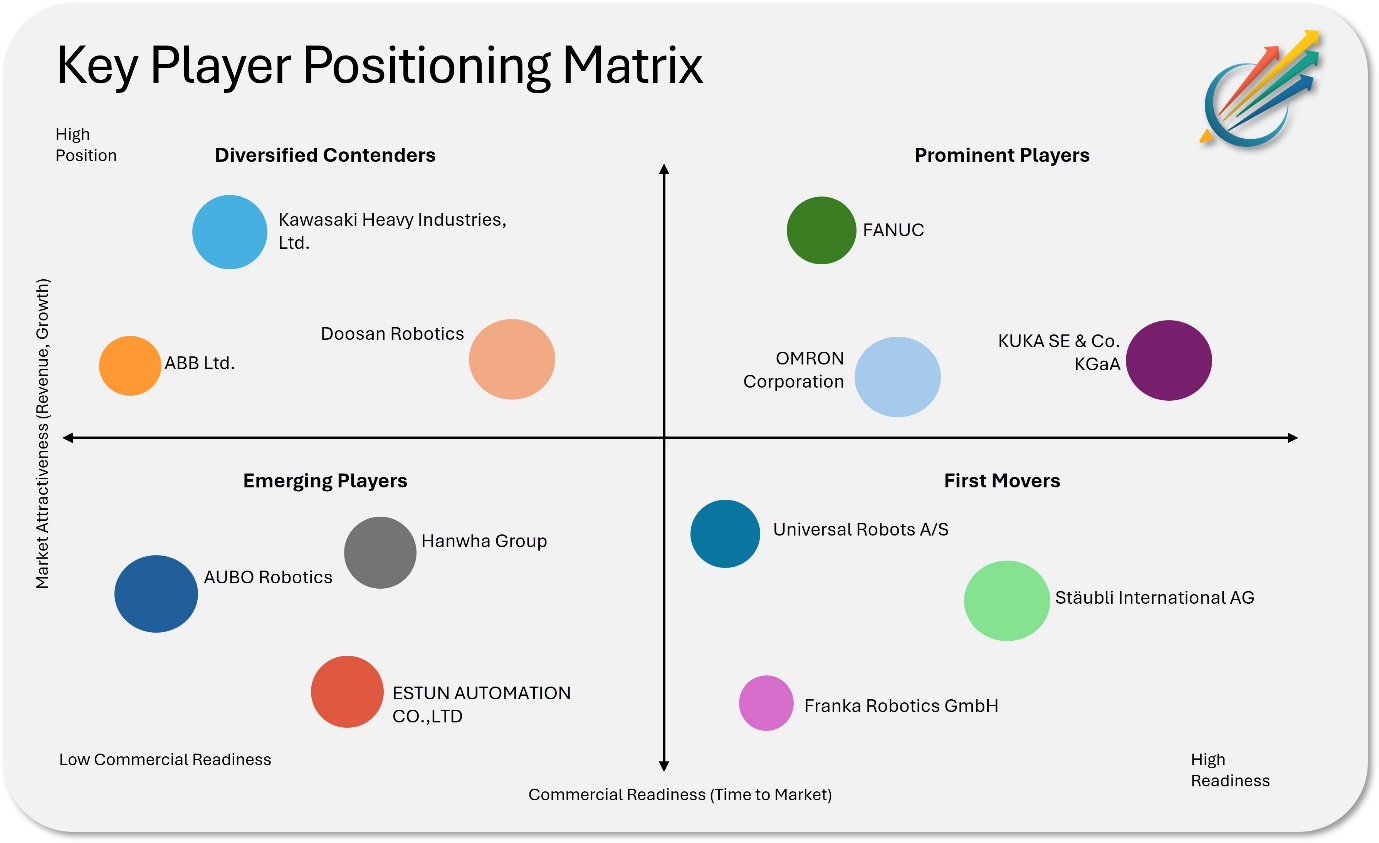
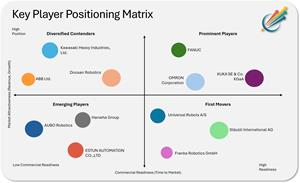
Collaborative robots market is characterized by strong innovation and increasing competition among robotics manufacturers and technology companies. Leading firms are focusing on improving robot’s intelligence, safety capabilities, ease of programming to expand adoption across various industries. Companies are investing heavily in AI-powered vision systems, advanced sensors, modular robotic platforms designed for flexible deployment. Strategic initiatives such as, technology partnerships, robotics ecosystem development, acquisitions of automation software companies are becoming common as market players seek to strengthen their competitive positions.
Key Players in the Collaborative Robots Market are
- Universal Robots A/S
- ABB Ltd.
- FANUC
- KUKA SE & Co. KGaA
- Yaskawa America, Inc.
- OMRON Corporation
- Techman Robot
- Doosan Robotics
- Denso Wave Incorporated
- Kawasaki Heavy Industries, Ltd.
- Epson America, Inc.
- AUBO Robotics
- Hanwha Group
- Franka Robotics GmbH
- Stäubli International AG
- Kinova Inc.
- ESTUN AUTOMATION
- SIASUN Robot & Automation
- Neobotix GmbH
Key Developments:
- In March 2025, Universal Robots announced the integration of NVIDIA Isaac Manipulator into its Polyscope software, enabling real-time adaptive path planning in dynamic environments.
- In May 2023, Techman Robot introduced the "AI-Vision Native" TM25S, the first cobot with a built-in Large Vision Model capable of recognizing undefined objects without prior training.
- In October 2025, SoftBank Group Corp. agreed to acquire ABB’s Robotics division for USD 5.4 billion, with the transaction expected to close between mid and late 2026.
- In June 2024, Fanuc Corporation announced plans to expand its production facility in Canada to strengthen its position in the collaborative robots market.
Explore the Full Industry Intelligence Suite: https://marketmindsadvisory.com/collaborative-robots-market/
Trending Related Reports
The warehouse robotics market has transformed from experimentation and pilot programs to commercial and scalable and critical deployment across global supply chains.
The industrial robotic motors market is set for significant expansion, reaching an estimated valuation of USD 2.2 billion by 2025.
The industrial robot controllers market is projected to witness substantial growth, reaching a market value of USD 3.6 billion by 2035, up from USD 2.1 billion in 2025.
The glass handling robot market is projected to grow from USD 827.2 million in 2025 to USD 1,272.9 million by 2035, reflecting a CAGR of 5.8%.
The dispensing robots market is expected to witness significant expansion, reaching USD 2.5 billion in 2025 and projected to surpass USD 6.46 billion by 2035.
The medical robots market is poised for substantial growth, expanding from USD 11.5 billion in 2024 to USD 39.7 billion by 2034, reflecting a robust CAGR of 13.9% over the forecast period.
The medical rehabilitation robotics market is projected to reach a valuation of USD 429.9 million by 2024, expanding at a compound annual growth rate (CAGR) of 16.2%, to achieve approximately USD 2.77 billion by 2034.
The coatings and application technologies for robotics market are projected to achieve a valuation of USD 19.14 billion by 2024, growing at a CAGR of 8.9%, and is expected to reach approximately USD 40.92 billion by 2034.
The industrial robotics market was valued at USD 20.8 billion in 2026 and is projected to reach USD 48.3 billion by 2033, reflecting a robust CAGR of 12.9% from 2026 to 2033.
The industrial robots market was valued at USD 18.7 billion in 2026 and is projected to reach USD 41.2 billion by 2033, reflecting a CAGR of 12.2% during the forecast period.
Why choose Market Minds Advisory
Market Minds Advisory delivers decision-grade intelligence trusted by executives across machinery & equipment, packaging, chemical, automotive, information & communication technology, food & beverage, consumer goods, healthcare and other industries. We provide market expansion strategies, go-to-market strategies, market share acceleration, brand positioning analysis, and account enablement and growth. Our forecasting methodology integrates primary interviews, proprietary demand models and continuous market validation to ensure accuracy in volatile and emerging industries. With over 10 years of industry experience and insights derived from primary interviews with several industry stakeholders, our research provides actionable insights and white space analysis for the emerging segments providing the opportunity gaps in the market accounting recent market developments and geopolitical risks. We believe in unlocking growth by helping businesses to see the future of their markets.
Contact Us
Market Minds Advisory

86 Great Portland Street, Mayfair, London,

W1W 7FG, England, United Kingdom

T: +44 020 3807 7725

Email: sales@marketmindsadvisory.com
Website: https://marketmindsadvisory.com/
LinkedIn | Facebook | Twitter | Instagram
Attachments

Market Minds Advisory 86 Great Portland Street, Mayfair, London, W1W 7FG, England, United Kingdom T: +44 020 3807 7725 Email: sales@marketmindsadvisory.com

Collaborative Robots Market
Collaborative Robots Market Outlook
Collaborative Robots Market
Collaborative Robots Market Dynamics
Collaborative Robots (Cobots) Market
Collaborative Robots (Cobots) Market Key Player Positioning
Legal Disclaimer:
EIN Presswire provides this news content "as is" without warranty of any kind. We do not accept any responsibility or liability for the accuracy, content, images, videos, licenses, completeness, legality, or reliability of the information contained in this article. If you have any complaints or copyright issues related to this article, kindly contact the author above.
